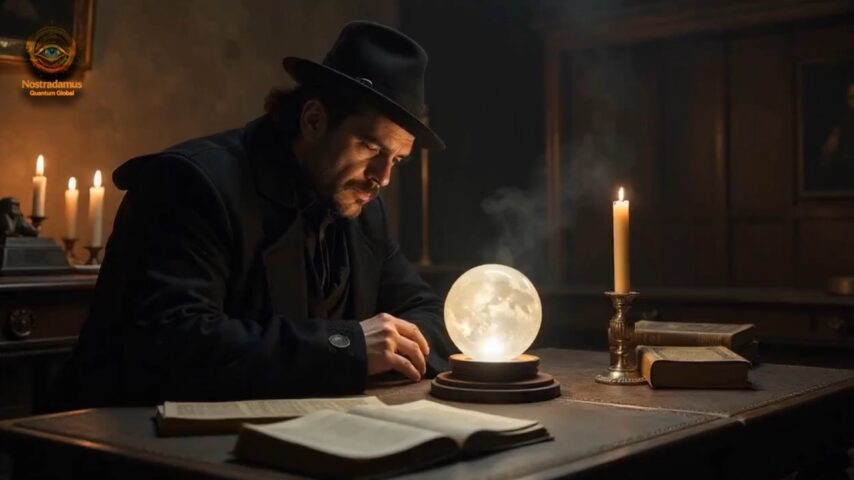
What would you do if the fate of the next five years were already written? Our journey today proposes a trip into the future, exploring the predictions of Nostradamus Quantum, a visionary whose visions trace a disturbing, yet hopeful, map of humanity's destiny between 2025 and 2030.
In this revealing analysis, we won't explore fantasies, but rather potential realities based on tangible trends that are already shaping our time. This video is a call to reflection, an invitation for those responsible for shaping our future: decision-makers, educators, and leaders.
Will you answer this call? Nostradamus Quantum doesn't predict destiny with mysticism, but with a keen eye for global events. These predictions are maps that warn us of a path fraught with challenges and illuminated by opportunities. And while some signs may be alarming, this map also reveals how we can redirect the course of our history.
Three critical areas shape our future: climate, technology, and society. This video dissects each of these pillars with precision and clarity, proposing solutions that could make the difference between collapse and rebirth.
Climate change is no longer a distant threat. Its effects are being felt now, and between 2025 and 2030 these consequences are expected to be even more severe. Extreme weather patterns such as droughts and massive floods will amplify food and water crises in the most vulnerable regions.
For some economies, this will mean significant financial losses due to environmental degradation and more frequent disasters. And for biodiversity, it could be the point of no return. However, the Nostradamus Quantum map also identifies opportunities.
With bold policies, such as the accelerated transition to clean and sustainable energy, we can slow the damage and ensure a more livable future. If countries commit to ambitious climate agreements and leaders ramp up their efforts in green innovation, the impact can be significant. Time is a scarce resource, and political will is the most valuable tool to prevent the clock from ticking to zero.
Technology is advancing at breakneck speed, and the period between 2025 and 2030 will be no different. On the contrary, new innovations, from advanced artificial intelligence to biotechnology, could change our lives in unimaginable ways. On the one hand, these technologies promise efficiency, new markets, and solutions to previously insurmountable problems.
On the other hand, they represent significant risks. Technological advances without a proper ethical framework could further deepen global inequalities, erode citizens' privacy, and systematically exclude vulnerable populations. The key challenge here is to ensure that technology is not only advanced, but also inclusive and ethical.
This requires global leadership committed to developing robust regulatory frameworks and fostering collaboration between the public and private sectors. In this way, technology can become a pillar of equity, not a divisive force. Our social systems are not immune to climate or technological change; on the contrary, they are deeply interconnected.
Over the next five years, we will witness intensified pressure on resources, which could exacerbate inequalities and geopolitical tensions. Population displacement will increase, whether due to natural disasters, economic crises, or armed conflicts. And these migrations will test global cooperation infrastructures and human rights norms like never before.
At the same time, at the heart of this social evolution are the values that shape our cultures. While some proponents of progress will advocate for more open and inclusive societies, others will seek to cling to traditional hierarchies, which could deepen social polarization. Our Damus Quantum, however, not only highlights these divisions but also offers a perspective: education.
This is the bridge that can close gaps, empower future generations, and foster a spirit of global cooperation in the face of uncertain times. Throughout human history, critical moments have been defined by the decisions made at key junctures. The period we are discussing now, 2025 to 2030, is one of those critical points.
The predictions of the new Nostradamus are not an immutable destiny, but a guide. Humanity possesses a unique and valuable power: the ability to choose. We have the resources, the innovation, and the knowledge necessary to change course, but everything depends on us—on you, on me, and on the leaders we elect to guide our world through these most uncertain times.
This is a call to act boldly now. Policymakers must commit to concrete actions, from bold environmental policies to inclusive ethical frameworks, from building resilient societies to fostering strong global cooperation. The map we've drawn leaves us with two possible outcomes: one where collapse consumes us, and another where our collective action leads to rebirth.
Which will you choose? The answers to the challenges presented here will define not only our next five years, but possibly centuries of human history. Let us not bow down to fear; let us use what we know as a tool to mobilize. The future belongs to those who make decisions today.
Will you be part of the rebirth or the decline? The choice, as always, is in our hands. A look to the future. The new Nostradamus Quantum 2025-2030 is the future.
This video is a call to reflection, an invitation to those responsible for shaping our future: decision-makers, educators, and leaders. Will you answer this call?